Why your SaaS free trial
Is Not Converting:
What We Found When
We Stopped Fixing the Funnel

|
Summary
Latest insights. Straight to your inbox
01 – the before
Analytics are lying to you
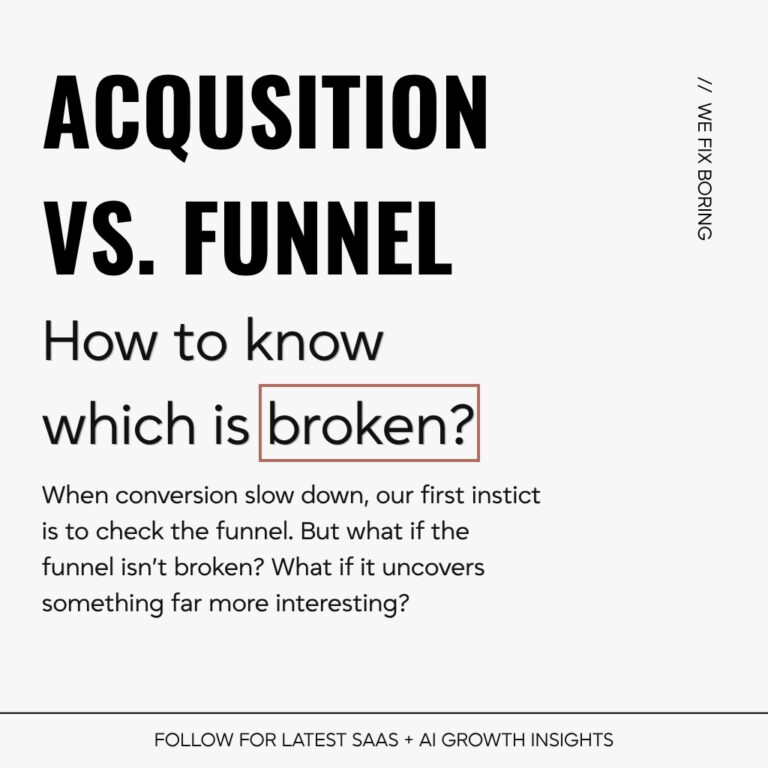
At Aimfox, free-trial signups grew by roughly 40% over a three-month stretch. Paid conversions stayed flat. The conversion rate dropped, week over week, for two months straight.
Everyone on the team looked at the same dashboard and reached the same conclusion: something was wrong in the funnel.
They were right that something was wrong. They were wrong about where.
It wasn’t a funnel problem. It was an audience problem. And it had been building for months before the conversion rate said so.
UP
Free-trial signups grew.
FLAT
Paid conversions stayed flat.
DOWN
Conversions rate dropped.
We run a weekly KPI review at Aimfox. Every Monday, the same numbers. Signups up. Activations flat. The conversion rate sliding in increments small enough to explain away, large enough to worry about.
The team’s response was logical. We looked at onboarding. We looked at the email sequences, the activation triggers, the time-to-value. We ran experiments. We rebuilt the first-run experience. The work was careful, well-executed, based on real data.
The conversion rate kept dropping.
ChartMogul’s 2026 SaaS Conversion Report puts the median free-to-paid rate across B2B SaaS at 8% — with “good” sitting at 6–10% and “great” at 15–20%. When your rate falls below that range, the natural place to look is the process between signup and payment. That instinct is usually right. At Aimfox, it sent us in the wrong direction.
Work with Andrej
Is your conversion rate dropping?
A quick discovery call to find out if the Conversion Gap diagnostic can help you.
the median free-to-paid rate across B2B SaaS is at 8% — with "good" sitting at 6–10% and "great" at 15–20%.
Source: ChartMogul's 2026 SaaS Conversion Report Tweet
02 –the diagnosis
What the data said when we stopped looking at the funnel
The moment of clarity came from a segmentation run on product event behaviour. I noticed that some people never opened our emails. And if I ignored that audience, the conversion rates were fine. More than fine, they were brilliant. That’s where the realization hit: We have two very different audiences.
One segment was completing activation events at normal rates and converting better than it ever had. The other wasn’t opening the first email. Not failing the onboarding — not engaging at all. There is no version of a better email sequence that moves a user who doesn’t open the first one. There is no first-run experience improvement that reaches someone who doesn’t come back after signup.
The blended conversion rate had been averaging these two populations together for months, and every week it reported the expected result: slow, steady decline. Because the second population was growing as a share of total signups — slowly, by increments, undetectable in a weekly dashboard — and dragging the average down.
Andrew Chen, Reforge founder and former head of growth at Uber, calls this the tyranny of the majority:
“Making decisions that appeal to a broad audience might attract low-value international users at the expense of high-value US users, and it takes a while to unentangle which segments you actually care about, particularly if they are the minority of your users.”
Substitute your own segments for the geographic framing and the observation is exact. The blended number told us what happened on average. It didn’t tell us which population was dragging the average down. That required looking one level deeper.
Two populations. One metric. The number averaged them together and pointed the team at the wrong problem.
03 – the intervention
What we changed (and what we stopped doing)
Once the diagnosis was clear, the intervention was straightforward.
The root cause was acquisition. Aimfox’s paid campaigns had originally targeted churned competitor users — people who had already paid a competitor, found it wanting, and left. A small, high-quality audience with demonstrated intent. Google’s algorithm, optimising for conversions, identified these users as high-value and did what it is designed to do: find more people like them.
The problem is that this pool runs out. Google documents this behaviour under “optimised targeting” — a feature that “finds new and relevant audiences” beyond defined segments using signals from landing page content and creative. Once the high-intent audience is exhausted, the algorithm expands outward to adjacent users who share surface-level characteristics but not the buying intent. This gets worse over time. It is a scaling problem and it is invisible at the channel level. “Google Ads” as a single row in a dashboard shows one number. The campaign-level breakdown shows two.
The fix was acquisition diversification: not better ads within the exhausted pool, but new channels with audiences we hadn’t yet saturated.
Specifically: five new Google Ads campaigns targeting different intent signals, two new Meta Ads campaigns, and one entirely new channel we had been testing. The goal was to reduce the proportion of traffic coming from the diluted pool and replace it with traffic that still had access to high-intent buyers.
The fix was upstream of everything the team was working on. That’s what made it hard to see — and hard to stop.
"Making decisions that appeal to a broad audience might attract low-value international users at the expense of high-value US users, and it takes a while to unentangle which segments you actually care about, particularly if they are the minority of your users."
Andrew Chen, Reforge founder and former head of growth at Uber Tweet
04 – the after
What moved (and how fast)
The acquisition restructuring moved numbers that six weeks of funnel work had not.
Cost per signup: $6.52 → $2.30.
Cost per paying user: $80 → $49.
The conversion rate stabilised and turned within weeks of the acquisition change. The numbers the team had been trying to move with email sequence improvements and first-run redesigns moved when we changed where the signups were coming from.
There is still work ahead. Conversion has recovered but not fully. The segment problem revealed other things worth addressing, and acquisition diversification is an ongoing process. But the metric that had been declining for two months responded to the right intervention almost immediately.
I’ve seen the same mechanism in client work. At a company called Elia, we found three completely separate audience types accumulated inside one blended conversion metric. The number looked like a moderate conversion problem — the kind that could be fixed with better onboarding and a messaging refresh. When we separated the populations and addressed each on its own terms, conversion improved 12x. Same misdiagnosis. Different product.
The numbers moved when we fixed the right thing. That sounds obvious. It takes two months of funnel work to make it feel that way.
05 – the bridge
How to know if this is your situation
The Aimfox pattern is recognisable. Here is how to check whether you are inside it.
• Your funnel fixes aren’t moving the metric.
This is the clearest signal. Funnel problems respond to funnel work. If you have run multiple onboarding experiments, updated the email sequences, improved the first-run experience, and the conversion rate has not moved — you are not looking at a funnel problem. The funnel is a plausible explanation for the symptom. It is not the cause.
• Your activated users are converting normally, but overall conversion is falling.
Segment your trial cohorts by activation event completion. If users who reach your activation milestone are converting at the same rate they always have, the funnel is working. The problem is the proportion of users reaching that milestone. That is an audience problem.
• Email open rates have diverged across acquisition campaigns.
This often appears before conversion drops significantly. If trial users from one campaign open sequences at 40% and users from another open at 8%, you have two audiences — not one audience with a messaging problem. Segment by campaign, not by channel total. The campaign-level breakdown is where the split becomes visible.
• Your best customers still trace back to the same acquisition sources.
Pull your lowest-churn, highest-engagement paying users from the last 90 days. Where did they come from? If the answer hasn’t changed, the degradation is coming from a different population entering through a newer or expanded source. The original channel worked. It’s producing a different kind of user now.
The broader pattern — how GTM channel exhaustion drives this same dynamic across the whole growth engine — is something I wrote about in Your B2B SaaS GTM Motion Has an Expiry Date. And if the audience composition shift is creating what looks like a positioning or messaging problem, that pattern is covered in Your SaaS Growth Stall Is Actually a Positioning Problem.
The question to ask before the next onboarding sprint: Are the people entering this trial capable of converting at all?
Work with Andrej
Is your conversion rate dropping?
A quick discovery call to find out if the Conversion Gap diagnostic can help you.